





Photo by Antoine B.
The Quiet Hack. How Vipassana Became a Tool of the Tech Elite
Tech CEOs spent years trying to hack productivity from the outside. Vipassana offered a harsher proposition: to turn inward and confront the mind itself.
Mystic Billionaires
In December 2018, Jack Dorsey, then CEO of Twitter and now the head of the fintech company Block, Inc., said he had completed 10-day silent Vipassana retreat in Myanmar. He did it to “reprogram the mind” and clear perception – to step out of the constant stream of stimuli and find inner stillness and clarity. He said the practice helped him shed accumulated noise, restore focus, and respond less impulsively.
Choices like these show how far tech leaders will go in search of calm. And the impulse is spreading: more and more business leaders, from Ford Executive Chair Bill Ford to Salesforce CEO Marc Benioff, have made meditation part of their daily routines.
Modern “yogis” no longer sit only on Himalayan peaks; they’re at home among skyscrapers. You’ll find them in corner offices, trading floors, and on stages, because at its core, is knowledge – how to manage yourself, conserve energy and clarity.
Microsoft CEO Satya Nadella starts his day with a brief mindfulness practice to keep focus and composure. Bill Gates meditates 10 minutes two or three times a week. Google’s Sundar Pichai, who struggles with classic meditation, sometimes uses NSDR/yoga nidra via YouTube. Jeff Weiner, former CEO and now Executive Chairman of LinkedIn, champions compassionate leadership and practices mindfulness regularly. Vladislav Doronin, Chairman & CEO of Aman Group, has built wellness into the brand and underscores its role in strategy.
A newer generation of performance-focused founders speaks about meditation in a far more practical language. Will Ahmed, founder and CEO of WHOOP, has said that meditation is part of his daily routine, describing a 10–20 minute morning practice he has maintained for more than a decade. The shift is telling: what once sounded spiritual is now increasingly framed as a tool for recovery, attention, and state management.
Pavel Durov, CEO of Telegram, belongs to a slightly different category. He has not made meditation retreats part of his public image, but he has openly described an unusually ascetic lifestyle built around fasting, long sleep, minimal phone use and strict control over distraction. In the broader culture of tech elites, that discipline belongs to the same impulse: the search for clarity through subtraction
Vipassana Culture
Vipassana (a Pali word meaning “clear seeing”) is a meditation discipline practiced by Buddhist contemplatives for millennia. A growing body of research suggests it can support mental and physical well-being. In Buddhist teaching, meditation offers direct insight into human subjectivity, insight that bears on ethics and on how happy we can be.
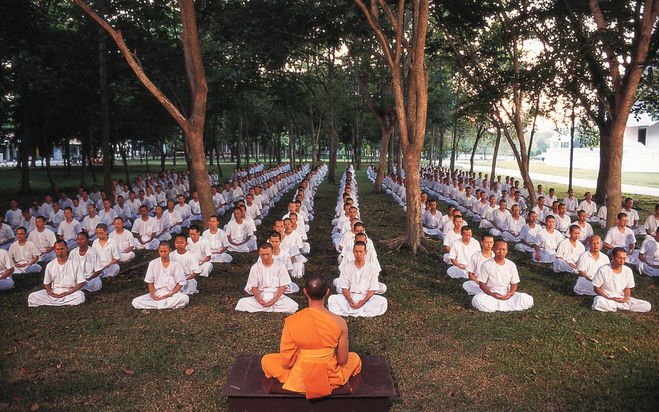
But Vipassana is a radical form of meditation. It differs from other forms: there are no mantras and no contemplation of deities. You sit in silence and observe bodily sensations like breath and posture, training attention to notice, moment by moment, how mind and body move together. The task is precise awareness of whatever arises: images and sounds, sensations, thoughts, intentions, emotions. It is believed that such observational practice develops the skill of managing one’s attention and concentration.
Vipassana took root in India, where the Buddha taught it some 2,500 years ago, then spread to Myanmar and Sri Lanka. In the 20th century it re-entered India through S.N.Goenka, a Burmese-Indian businessman who began teaching widely in 1969 after training with U Ba Khin.
Goenka described Vipassana as “surgery of the mind” and later founded the nonprofit Vipassana Research Institute, which coordinates courses worldwide. Today there are more than 393 centers in about 94 countries. Goenka presented Vipassana as an experimental, non-sectarian discipline: by observing the mind’s ever-changing nature, one cultivates deep self-knowledge and a steadier, happier life.

What once sounded spiritual is now increasingly framed as a tool for recovery, attention, and state management – and, by extension, as something with clear economic value, in a market now worth billions.
People enroll seeking peace and perspective on what makes them unhappy. Those wanting a gentler on-ramp can find it elsewhere; Vipassana is demanding. A standard 10-day course asks for about 10 hours of meditation per day, wake-up at 4:00 a.m., Noble Silence (no speaking or nonverbal communication), simple vegetarian meals, and basic, separate accommodations for men and women.
Reading, writing, phones, music, exercise, and eye contact are set aside to minimize distractions. New students have their last full meal before 11:00 a.m. and in the evening may take tea with milk and a small portion of fruit; old students take tea or juice only in the evening. The early days often reveal how little control we have over thought. That realization can feel like being a puppet of one’s own mind – and can motivate the work of freeing attention from its habits.
In modern society, if you talk to yourself out loud all day, you will be considered insane. But talking to yourself inwardly – that is, thinking continuously – is considered perfectly normal.
From the Buddhist point of view, constant identification with discursive thoughts is a kind of madness, albeit a very familiar one. As some retreat participants have found, when thoughts are perceived as mere phenomena arising and passing in consciousness (along with visual images, sounds, sensations, etc.), the sense of an “I” that thinks these thoughts can disappear. This experience of non-self is interesting for two reasons: it is completely logical from a neurological standpoint, since in the brain there is no privileged position that an “I” could occupy. The loss of “self” can also be deeply liberating.
Vipassana course is free, but not everyone completes it. Some leave mid-retreat, struggling with boredom, physical pain from long sitting, or anxiety that surfaces when ordinary distractions fall away.
For people with unstable mental health, the retreat may be inappropriate. But those who persevere and complete all 10 days usually gain something far more important than just tears from leg pain. Through this technique, they clear the mind, reactivity, and accumulated stress.
Spiritual Biohacking
In the past, spiritual retreats drew mostly people from the “counterculture.” Lately, more and more people from the “mainstream” have been showing up – professionals and leaders seeking intentional self-development. The currently fashionable Silent retreats, with their waitlists of Silicon Valley “refugees” (Microsoft and Amazon engineers among them), often look like a splice of ancient contemplative methods with startup-style lifestyle engineering.
In the Valley, these practices have steadily moved into the mainstream, and meditation now sits within a much larger digital wellness economy. Grand View Research estimates the global meditation apps market at $2.2 billion in 2025, while the wider mental health apps market reached $7.48 billion in 2024. The business case is no longer marginal: the 2021 Headspace–Ginger merger valued the combined company at about $3 billion, while Calm’s last widely cited private valuation was about $2 billion in 2020.
Vipassana courses in major centers still fill months in advance and advise applying early. Special 10-day executive courses are now held specifically for business executives, government officials, and other professionals, which shows that the practice has already been adapted to the language and pressures of high-responsibility environments
Ambitious techno-perfectionists come to retreat to be “more effective,” treating meditation as a tool to boost cognitive throughput. But taken that way, practice can backfire: instead of quick gains, people meet their anxiety and inner turmoil at close range. First-timers don’t always grasp what they’re in for. Nearly everyone hits the same discovery – how little control they actually have over their thoughts.
With regular practice, meditation builds concentration and sustained focus, which helps in business. It’s no surprise that new Goenka-tradition centers are opening where you’d expect.
As the conscious living trend expands, a new archetype shows up: the optimizer – senior managers, founders, and performance-driven professionals, often men aged thirty-five to late forty – looking for an edge in work, sport, and relationships. The world grows more complex, and they want an edge at work, in sport, and in relationships.
After his second ten-day retreat, Jack Dorsey described Vipassana in engineer’s terms: “Vipassana’s singular objective is to hack the deepest layer of the mind and re-program it.” In other words, reboot the operating system and chase humanity’s old pull toward enlightenment.
“Vipassana’s singular objective is to hack the deepest layer of the mind and re-program it.” In other words, reboot the operating system and chase humanity’s old pull toward enlightenment.
The discipline trains perception to see the world “as it is,” arguing that if one can’t sustain bare attention for even a few minutes (such as observing the breath), it’s hard to assess reality without mental filters – a capacity he credits with making his writing possible.
If you sit down and watch your breath, and within a minute your mind will fill with thoughts that grab your attention. If you can’t spend even five minutes quietly observing the breath, how can you assess reality – global politics, or your business strategy – without the mind’s subjective filters? Try witnessing the world without judgment.
Psychologists note that the primary source of dissatisfaction is the fantasies we project onto objective reality; when they don’t match, stress follows. Self-observation shows how much suffering we impose on ourselves through our own faulty patterns of thought.
Still, the first retreat is hard for almost everyone: the schedule is strict, distractions are removed, and many confront anxiety, boredom, or physical pain from long sitting. For some, a ten-day silent retreat may be inappropriate; for others, the payoff is a steadier, less reactive mind.
Vipassana isn’t an intellectual pastime, a philosophical diversion, a vacation from the frantic world or from overwork, nor an escape from daily problems. It is a technique for cleaning the mind of the projections and limits it creates – obstacles to a full life. It is a meeting with the unvarnished self, and it isn’t always pleasant. Without that encounter, lasting happiness is unlikely.
One thing is clear: the rise in executive burnout is nudging priorities away from pure performance and profit-chasing toward inner balance. In an information-saturated world, demand for meditation retreats will only increase. Stress is high, and people want relief. Meditation is a simple, accessible method. Such retreats won’t suit everyone, but most probably it is worth attempting at least once in a lifetime.
Share




WE RECOMMEND

How to Train Your Brain for Optimal Longevity
The most mature idea in brain longevity today is this: the brain is preserved not when we try to “hack” it, but…

The healing power of sound. New approaches to feeling well
Today, more and more people are turning to sound as a practical way to downshift stress, because it can change how you…
Private Banking: Wealthy Are Spending Now Less On Status And More On Longevity
As performance and clarity start to influence deals and decisions, private banking is beginning to place health inside wealth strategy, alongside assets…
