




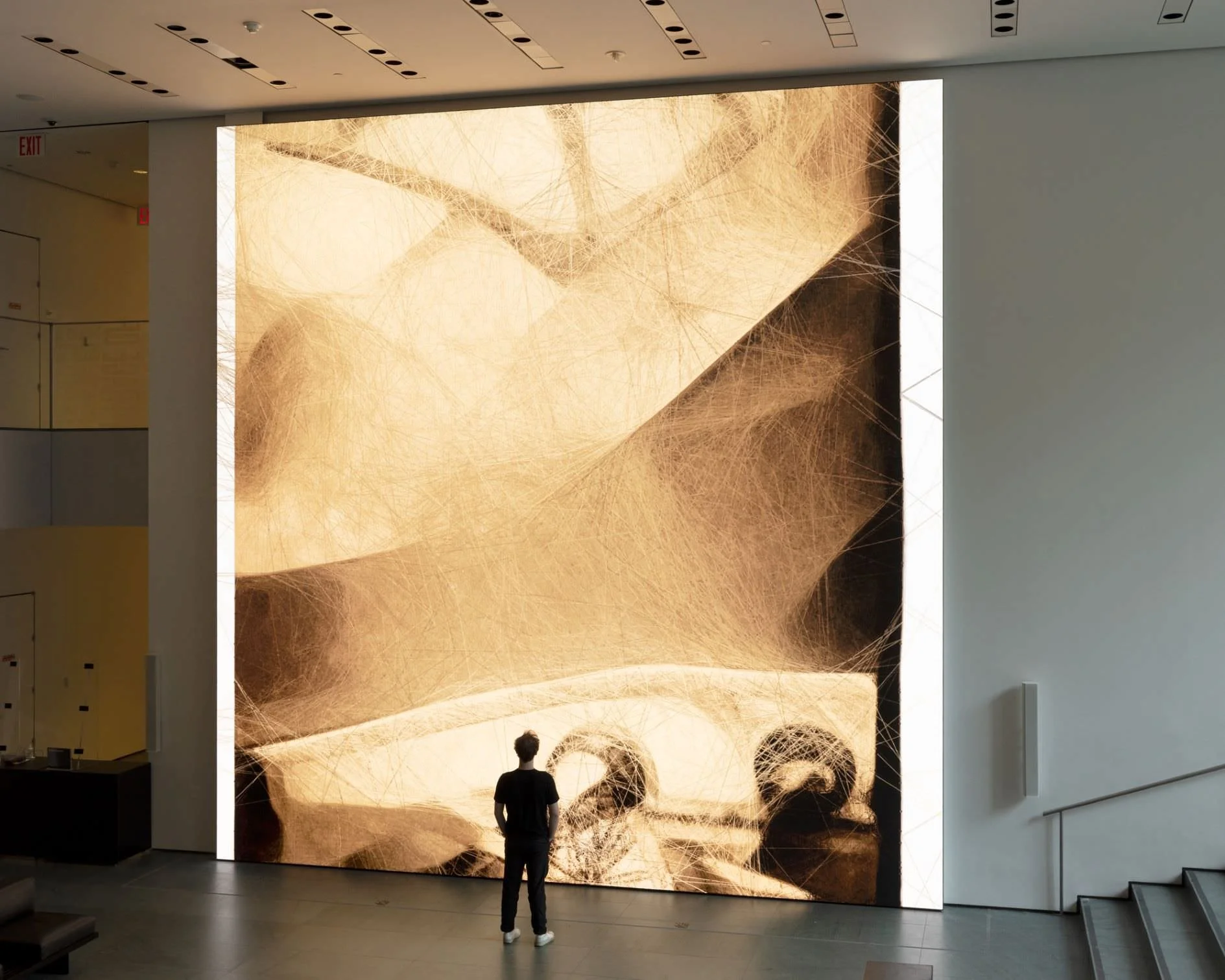
Refik Anadol: Unsupervised, The Museum of Modern Art, New York
The AI Artist Question
When a machine can generate the image, the real question is no longer who made it, but who is the author?
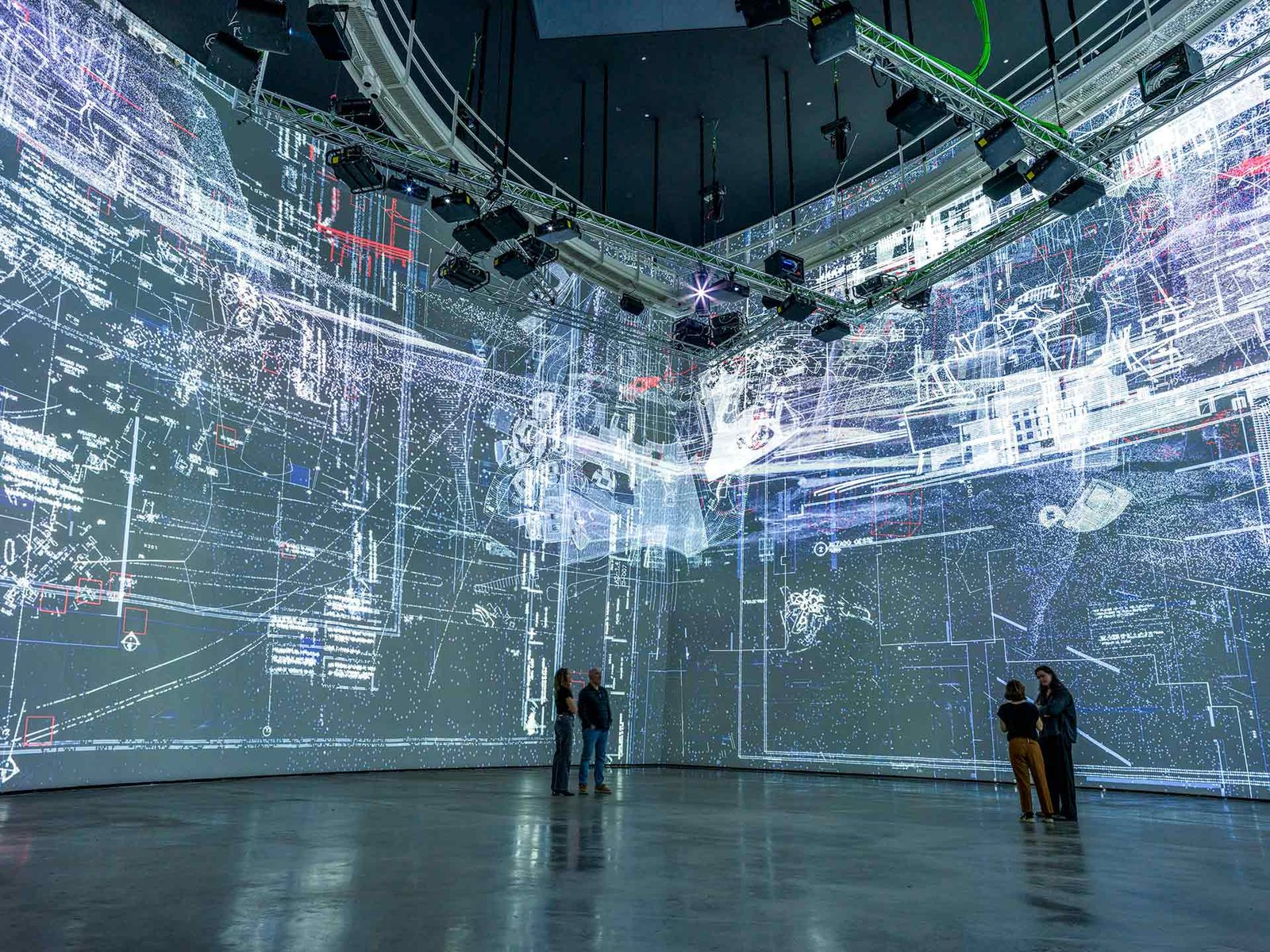
There is a work hanging in the permanent collection of MoMA that nobody painted. A 24-foot installation called Unsupervised, built by Refik Anadol and his studio, trained on 138,000 pieces from MoMA’s own archive – a machine dreaming through two centuries of art history and producing something new from the weight of everything that came before it. Visitors sat in front of it for an average of 38 minutes. In a museum where most great works hold attention for under 30 seconds, that is a number worth pausing on.
The question it raises is deceptively simple: who made this?
Refik Anadol describes data as a pigment – a brush that can think. Born in Istanbul, trained in architecture and media arts, now based in Los Angeles, he works at a scale that most artists cannot reach without the infrastructure of institutions. For one project, he used 200 million photographs of Earth. For another, 135 million images of the natural world, drawn from the Smithsonian, the Natural History Museum in London, National Geographic – all ethically sourced, all curated by human hands before the machine ever touches them. The AI system learns patterns from this material, then generates images that, in Anadol’s words, exist only in the mind of a machine. He then applies algorithms to shape those outputs into his signature aesthetic – fluid, molecular, hypnotic, moving in ways that organic matter moves and that no human hand could sustain.
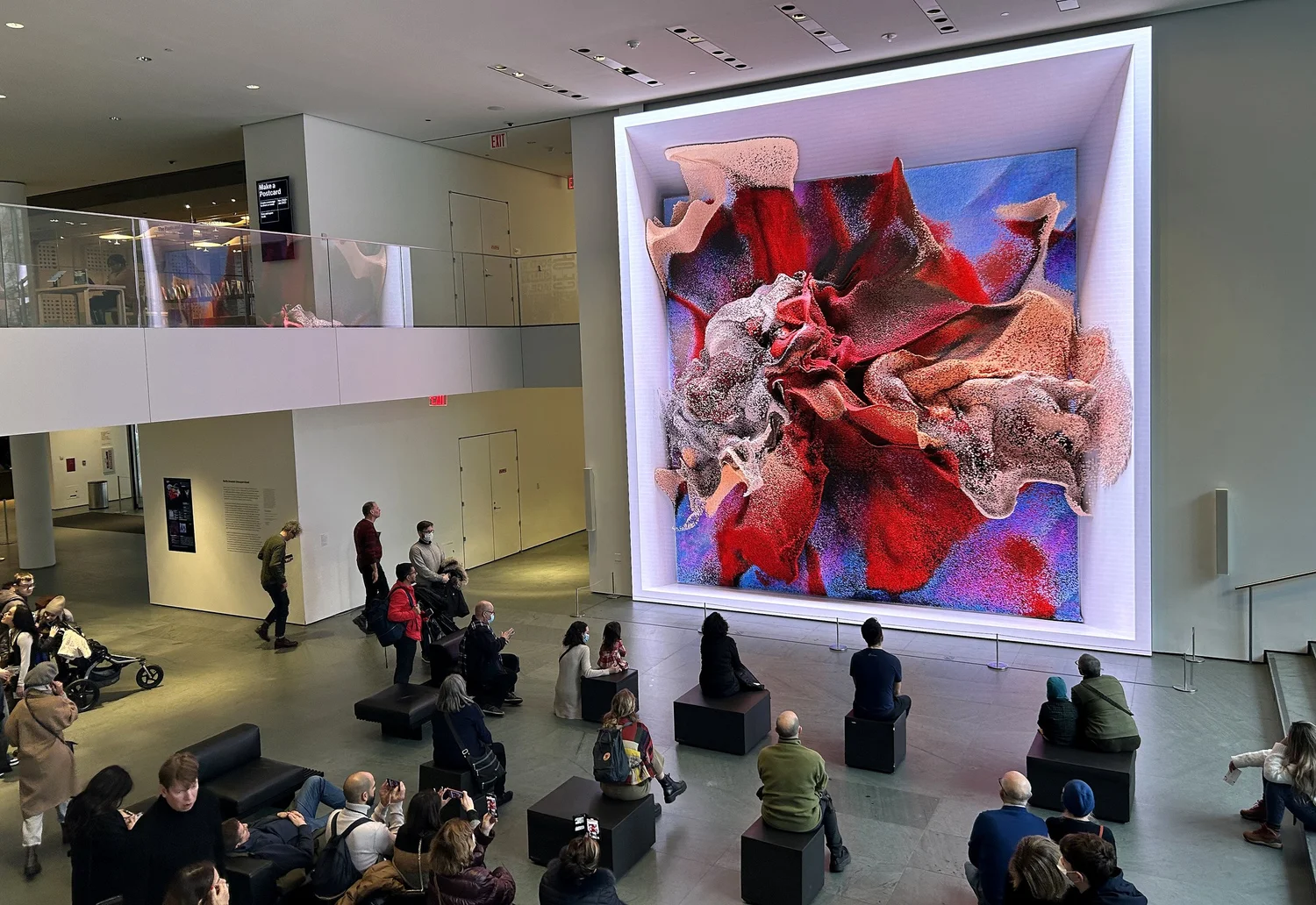
He has described his method as a thinking brush – a tool that holds its own logic while remaining guided by human intention. Pulitzer Prize-winning critic Jerry Saltz called Unsupervised a half-million-dollar screensaver. Glenn Lowry, the recently retired director of MoMA, described viewers finding it deeply satisfying. Both observations are accurate.
AI is never neutral: it inherits the biases of its datasets, which is why, for artists from underrepresented cultures, working with AI immediately becomes a political and cultural struggle.
On the other side of the equation – geographically, culturally, methodologically – stands Hassan Ragab. Egyptian, trained at the Faculty of Fine Arts in Alexandria, now working as a computational designer and conceptual artist in Southern California, Ragab arrived at AI through architecture and through frustration. When he typed Alexandria into an early image generation tool, the result depicted veiled girls. When he typed El Karnak, the output was abstracted to the point of meaninglessness. The 300 million images in the datasets were built primarily from the Western Hemisphere, leaving minimal representation of Middle Eastern and North African heritage – entering the digital world, as Ragab observed, without a clear Egyptian identification in virtual space.
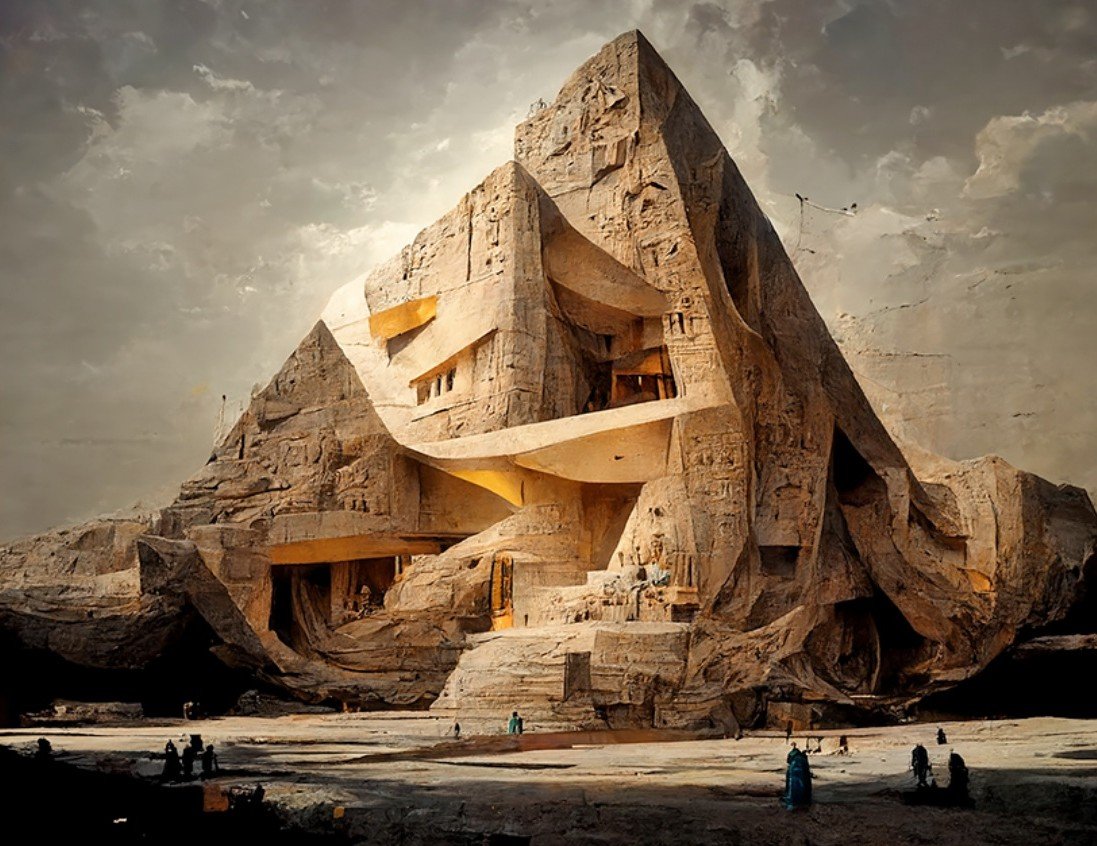
His response was to become, in his own phrase, an archaeologist of latent space – navigating the biases of the tool to find what it had buried, coaxing meaningful images of Pharaonic architecture, Islamic geometry, Alexandrian Art Nouveau from a system that would, left to its own tendencies, default to something far more familiar and far less his. His Cairo Sketches series uses AI to reinvestigate Islamic geometric patterns through more recent mathematical principles, revisiting architectural heritage and challenging the perception of both new technologies and cultural buildings. The work carries something that purely generated images rarely do: a specific cultural argument, made by a specific person, from a specific place. The machine is the medium. The archaeologist is the author.
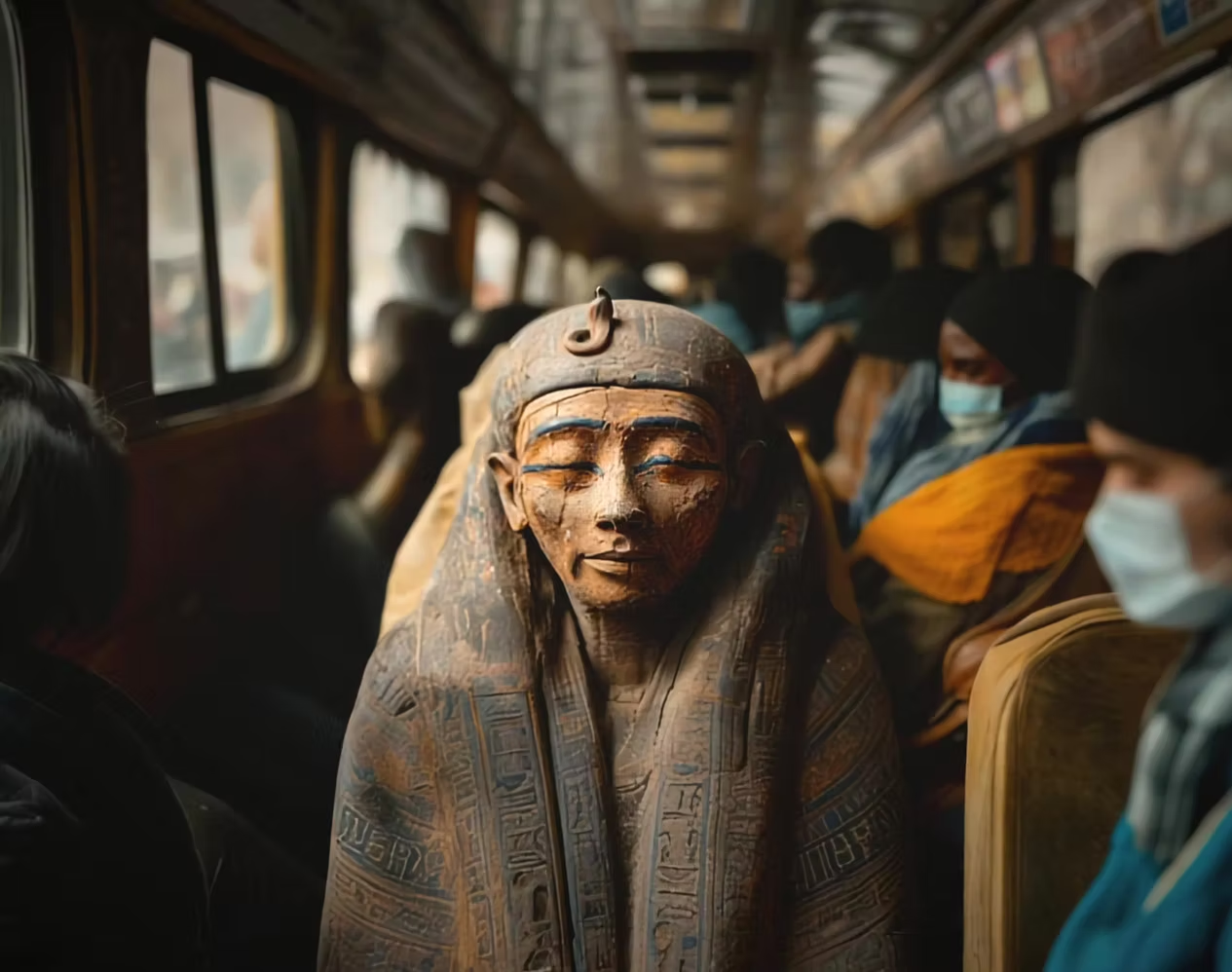
This distinction – between the artist who sculpts with data at scale and the artist who uses the tool to excavate an identity that the tool itself would erase – maps something important about where AI art actually lives. It lives in the friction between human intention and machine tendency. The more specific the human, the more interesting the friction. The more the artist brings of themselves – a cultural memory, a historical grievance, a particular way of seeing a city – the more the work resists the flattening that AI, trained on the aggregate of everything, naturally tends toward.
Anadol’s practice is optimistic about this collaboration in a way that draws both admiration and suspicion. He has built Dataland in Los Angeles – described as the world’s first museum of AI arts – with a belief that many artists are limited by a lack of access to computational resources rather than a lack of ideas, and that an institution can bridge this divide. Time The proposition is generous: that the thinking brush can be shared, that the democratisation of these tools expands what art is possible rather than diluting what art means. Whether institutions will absorb this without converting it into spectacle remains the live question.
The most important AI art being made today may be the work that makes the machine uncomfortable – that asks it to see what it was not trained to see.
Ragab’s concerns run in a different direction. His work consistently returns to what happens when a culture’s visual identity is shaped by tools built on someone else’s data. He asks what an Egyptian visual identity means to a language model that has absorbed the world’s images disproportionately through a Western lens – and what the costs are of placing cultural identities in the hands of those who control the data. LinkedIn When the algorithm fills in the gaps, it fills them with whatever it has seen the most. For cultures underrepresented in the digital archive, this is a form of erasure dressed as imagination.
This is where the authorship question becomes a cultural question, and a political one. Who built the dataset? Whose images dominate it? When a machine dreams of Cairo or Alexandria or Beirut, whose Cairo does it produce – and what does it mean for an Egyptian artist to have to fight the tool’s own biases simply to render his home city legibly? The brush that thinks, in this sense, does not think neutrally. It carries the weight of what it was fed. The artist who understands this – who works with the grain of the tool in some moments and against it in others – is doing something that goes beyond aesthetics. They are negotiating with a system of knowledge that was built without them in mind.
There is a generation of artists across the Arab world, sub-Saharan Africa, South and Southeast Asia for whom this negotiation is central to the practice – who use AI precisely because it forces this reckoning into the open, who find in the tool’s biases a kind of mirror showing what the digital world currently knows and does not know about them. They are making work that is simultaneously about its subject and about the limits of the medium representing it. This is a sophistication that the art market has been slow to recognise, in part because the market values what it already has language for.
Anadol, with his institutional relationships and his partnerships with Nvidia, Google, and MIT, has become the language through which the market currently understands AI art. His aesthetic is extraordinary, his vision is coherent, and his optimism is, on its best days, genuinely moving. But the broader conversation – the one that includes Ragab, and the artists still working without residencies or major partnerships or 20,000-square-foot museums – is where the more difficult and more necessary thinking is happening.
The tool has changed, but the standard has not. Authorship still belongs to the person who brings a distinct point of view, knows what the machine will do on its own, and pushes the work somewhere more specific, more conscious, and more human.
Share


WE RECOMMEND
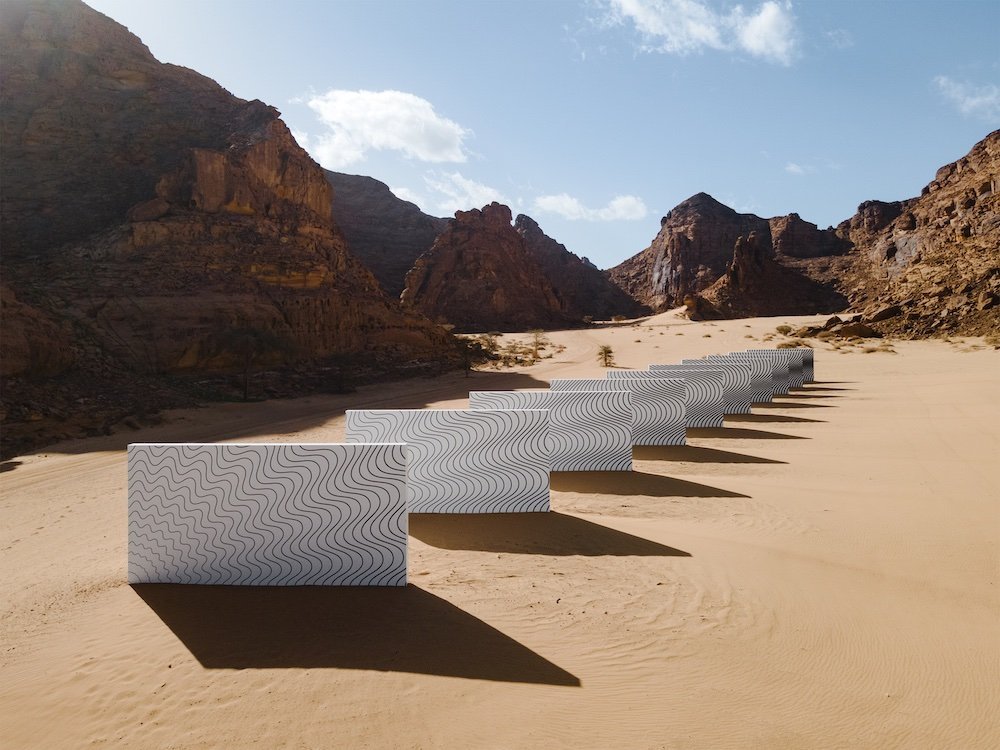
Desert X AlUla returns with a theme inspired by Kahlil Gibran
Desert X AlUla 2026 turned AlUla’s canyons into an open-air route of 11 new site-specific installations, with Kahlil Gibran’s Space Without Measure
Dubai to turn the desert into a 10-kilometer art gallery
Dubai’s desert is set to become the site of a walkable artwork called CLIO Desert Park – a land art route built…
Why Cairo’s Grand Egyptian Museum Is Worth the Trip
A pyramid-view museum built for scale and clarity – with Tutankhamun’s full 5,398-piece collection, the Ramesses II colossus, and galleries that finally…
