




“Dubai Doesn’t Let You Stop. That’s Exactly the Problem”
Dr. Sarah Rasmi, psychologist and founder of Thrive Wellbeing Centre Dubai, on anxiety in a city that never pauses, the illusion of the perfect life, and why time may be the ultimate luxury.
“Dubai Doesn’t Let You Stop. That’s Exactly the Problem”
Dr. Sarah Rasmi, psychologist and founder of Thrive Wellbeing Centre Dubai, on anxiety in a city that never pauses, the illusion of the perfect life, and why time may be the ultimate luxury.
In Dubai, wellbeing is often framed through longevity, fitness, beauty and performance. But mental health belongs in the same conversation. We spoke with Dr. Sarah Rasmi, who holds an M.A. and Ph.D. in Psychology from the University of Guelph in Canada, to understand anxiety, burnout and comparison from a lens of psychology.
Dr. Sarah, first of all, is it normal to experience anxiety right now, given everything that is happening in the Gulf region and in the wider world?
Everyone I know is experiencing some level of fear or worry, and it makes sense. There’s been a lot of uncertainty. The problem isn’t the anxiety itself. The problem is when it’s going on at a high level for too long – when it starts to take a real toll on your functioning.
How do you know when anxiety crosses the line?
It’s about extent, intensity, and frequency – and the impact it’s having on your life. It’s one thing to have a bad night’s sleep. It’s another thing to be awake at three o’clock in the morning, every night, for a month. That’s when you need to have a look at what’s going on.
If the only thing happening is disrupted sleep, maybe it’s a sleep-related issue. But if you’re not sleeping because you’re up thinking and thinking and thinking – that’s a symptom of anxiety disrupting your health. When it feels really out of the ordinary and things have changed a lot – that’s a really important time to reach out to a professional.
All of us have early warning signs. You might feel a knot in your stomach when you’re about to panic. We teach people to pay attention to their body – and when you feel that knot, instead of waiting until you reach peak anxiety, you take a walk, call a friend, smell something, eat something, whatever it is. Noticing the patterns and intervening right away is really important.
We actually have screening tools on our website – the PHQ-9 for depression and the GAD-7 for anxiety. These are gold-standard screening tools used by medical professionals all over the world. They give you a live score, and you can do them from the privacy of your own home in a couple of minutes.
Dubai seems to have its own kind of burnout – a very specific local kind. The outside of life looks extraordinary. But something breaks underneath. Have you noticed that pattern?
I have. We have a lot of high-performing overachievers here. Part of it is self-selection bias – around ninety percent of UAE residents are expats. We chose to come here. Either we came with our families as children or we chose to come as adults. And who are the type of people that want to come here? This is a land of opportunity. So they’re already wired to perform.
I would say people who come to Dubai are usually highly motivated, high-achieving, and often have perfectionistic tendencies – which is great. They succeed. They pursue. They have beautiful opportunities in front of them and they run with them. And life here is exciting. There’s always somewhere to go and someone to meet. Life doesn’t stop.
“We see so much burnout at the executive level – but also in young professionals, answering emails at three in the morning”
But that’s exactly the problem. There’s the pressure to say yes, to do more. And if you’re someone who’s used to achieving – we don’t give ourselves a moment of celebration after we get somewhere. You’re already looking for a new goal. After a certain point, it becomes too much. We see so much burnout at the executive level – but also in young professionals, answering emails at three in the morning, because they want to prove that I’m the one who has what it takes. And the problem is: it gets rewarded. So when you kill yourself working and you achieve, it encourages you to keep going. But you can’t go forever. Eventually it’s too much, and you crash. And that’s when they come to us.
Dubai offers a very visible version of a luxurious lifestyle. Do you think luxury itself – the visual pressure of it – can also contribute to anxiety?
What I would say to everyone is: we need to redefine luxury. Right now, when we use the word, we’re thinking about a home, a car, a handbag, a restaurant, a plane ticket. And all of those things are lovely. But is that what’s actually important to you as a person?
Or is a better luxury having control over your own time? If I want to have a two-hour lunch in the middle of the day, I have the flexibility to do that. If I need to pick up my child or go to Pilates, I can do that. Part of it is really thinking about what our priority actually is.
And the research on the psychology of money backs this up. One of our biggest luxuries in life is time – flexibility with time, having time to do the things we love. Studies show that money increases happiness, but with diminishing returns – and a lot of that has to do with whether you are lifting yourself from poverty or using your money to buy time. Sometimes we miss that completely, because of all the glitz and glamour surrounding us. Health is the most important thing. And health buys us time. It buys us time on this beautiful earth.

How do you find balance in a city that rarely slows down?
In my view, there’s no such thing as work-life balance. I think we have to manage our expectations. We’re never going to find the perfect equation. What I prefer is recalibration. If you have a hectic period, fine, you’re going to push yourself hard for a while. You probably won’t be sleeping well, you won’t be social, you won’t be having fun. That’s okay for a short period. Our bodies can handle it. But eventually, we need to come back. We need to give back to the other things we sacrificed.
So work-life balance for me is not thirty percent here, thirty percent there. It might be eighty-twenty for a while. And then sixty-forty. And then maybe eighty-twenty in the other direction. Recalibration. Our bodies are not designed to go a hundred miles an hour indefinitely. If you keep pushing and never rest, you will burn out – and it will cost you far more than if you’d taken a step back earlier.
The Gulf has one of the highest social media engagement rates in the world. Everyone is a public figure here. And with that comes a very specific feature – comparing your real life to someone else’s curated one. What’s your advice?
I love this question – because as a social psychologist, I’ll tell you: the advice ‘don’t compare yourself’ is very silly. It’s not possible. Our brains are not made that way. We have to compare ourselves. How do I know I’m short? Because when I look at people around me, most of them are taller. That’s how we understand ourselves.
So it’s all about having a balanced comparison. Number one: look across the whole spectrum, not just at the people who have the one thing you desire. Number two: there’s a huge difference between comparing yourself to someone you know and someone you don’t. If you see someone you know posting their beautiful life on Instagram – you know their real life. You know they had gained weight a year ago, or had a fight with their spouse. You know it’s a picture inside a full life of ups and downs. With influencers and strangers, we take it at face value – this is their life and everything is perfect. That’s why engaging with real people matters. You have accurate, full comparisons. That same kid who’s smiling at a birthday party had a meltdown yesterday. You know that.
There’s still a stigma around mental health here – especially for men. How can someone tell when it’s time to seek professional support?
In terms of real warning signs: number one, do I notice a change in how I’m showing up at work, with friends, at home, in my leisure? Number two, do I feel different than I did before? Number three, am I experiencing distress? Feeling not good is a warning sign – even if it’s a small thing, like not sleeping well for a couple of weeks. Or a bigger thing: you’re yelling at everyone, you’re missing deadlines, you can’t concentrate.
Is it distressing? Is it affecting multiple areas of your life? But I’d also say: just because you go to therapy doesn’t mean you’ll lie on a couch for two years talking about your mother. Maybe you’ll go for a few sessions just to talk through one problem.
It’s important to say that therapy is not about being told what to do. We help people understand what is happening, see the patterns more clearly, and reach their own conclusions. Sometimes we share structured tools, but therapy is not advice-giving. It’s a process of understanding.
Dubai is a city where everyone performs strength and success. Does that make it harder to be honest about what you are going through?
I’ll tell you something. I have my own professional social media pages and I posted something a few years ago: I’m a psychologist and I see a psychologist. And people reacted – like, really? Because there’s this idea that if you work in the field, you should have everything figured out. Just like there’s the idea that if you’re a successful influencer, your life must be perfect. Nobody has all the answers. Everybody struggles. And it doesn’t make us bad. It just means it’s nice to have someone to talk to – a space where you can share honestly, without worrying about judgment.
How do you see the future of mental health in the UAE?
I see a bright future. I’ve been here since August 2013. Even before I founded Thrive Wellbeing Centre, I had the privilege of working on government initiatives through the UAEU Emirates Centre for Happiness Research – with the Minister of State for Happiness and Wellbeing’s team on what was then called the National Programme for Happiness and Positivity (now known as the National Programme for Happiness and Wellbeing). I was part of some of those efforts. And I think that played a huge role in showing people that wellbeing is important and that struggling is okay.
“In my view, there’s no such thing as work-life balance. I think we have to manage our expectations. We’re never going to find the perfect equation. What I prefer is recalibration”
Research suggests around one in four people will experience depression and/or anxiety in their lifetime. It’s a lot of people. It’s common. Our experiences are similar. And we found that especially after COVID, enormous numbers of people started therapy who would never have considered it before. Shared struggle normalises suffering. And that makes it easier for people to reach out.
More people are being open about seeking therapy, and I really admire that. Because if you know you’re not the only one, it becomes much easier to make that call. And the earlier, the better.
You don’t have to wait until something is very wrong. Just like going to the doctor – you don’t have to wait for major symptoms. Sometimes you just feel not quite yourself. Maybe you could be healthier. That is actually the best time to go, because that is when you have the best outcomes.
Share




WE RECOMMEND

How to Sleep When the World Feels Unsettled
There are nights when the body is tired, but sleep still does not come easily. Or it comes lightly, in fragments. In…
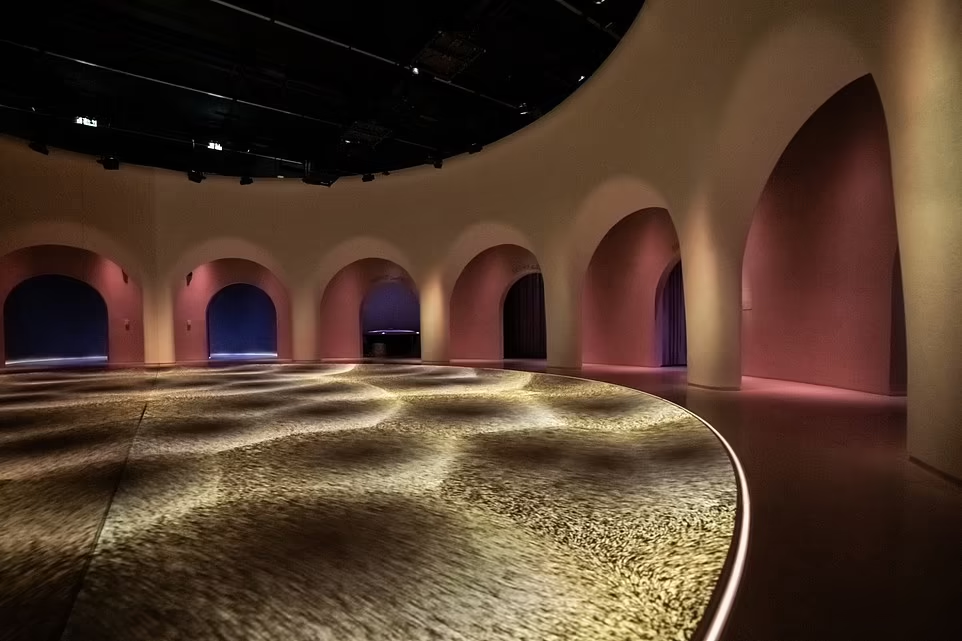
Dubai Built a Space to Calm the Nervous System
Rooted in Arab mind–body traditions and supported by advanced technology, ALWAHA treats the senses as a direct pathway to recovery and presence.

Wellbeing Spaces of the UAE
How Dubai, Abu Dhabi, and the wider UAE are turning wellbeing and recovery into a new urban culture.
