





The Billionaire Longevity Paradox
If wealth gives access to the best doctors and diagnostics, should billionaires live longer? We asked Alexey Strygin – CEO of the Longevity Economics Institute – what his analysis of billionaire lifespans reveals about money and ageing.
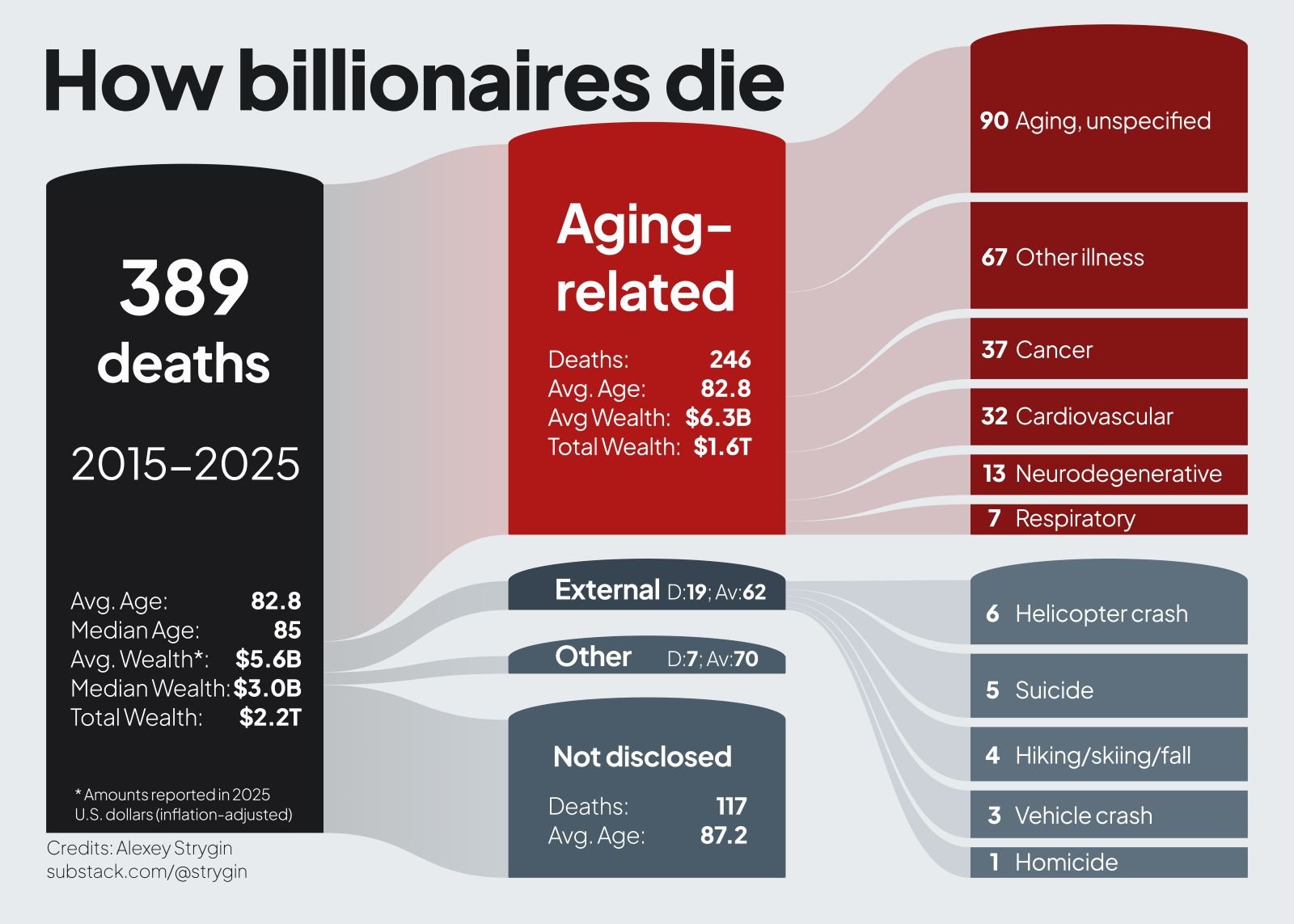
Biotech entrepreneur Alexey Strygin, whose work spans longevity biotechnology and AI-driven drug discovery, analysed 389 billionaires who died between 2015 and 2025 – and found that extreme wealth does not appear to translate into a radical lifespan advantage. The original article, “How Billionaires Die,” and his methodology can be read here.
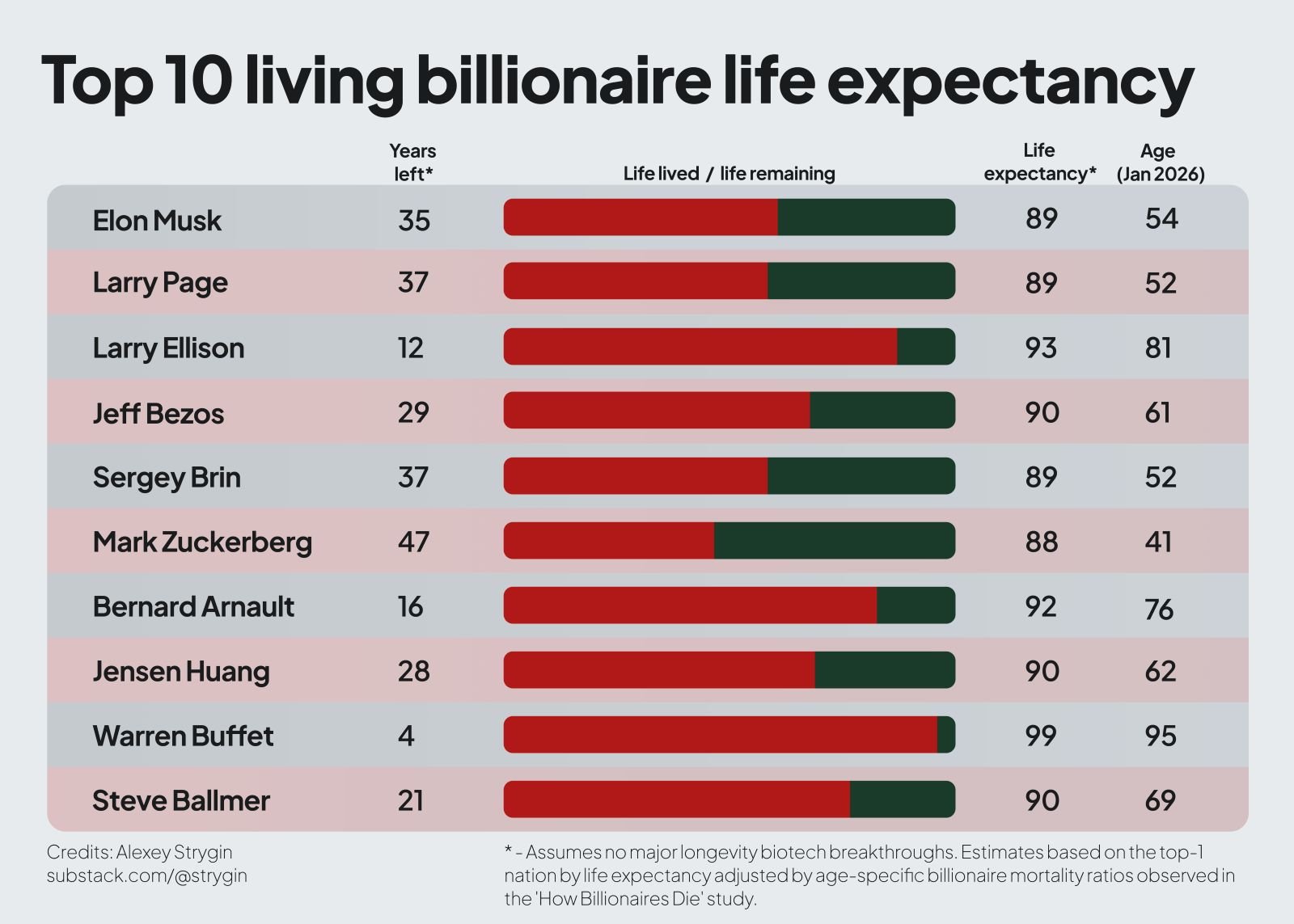
In brief, among male billionaires, the advantage appears limited – somewhere between zero and four additional years – and largely disappears after the age of 90. For female billionaires, the result is even more striking: instead of showing the usual female longevity advantage, they lived, on average, around 4.5 years less than Hong Kong women, who have the world’s highest female life expectancy.
We spoke with Alexey Strygin to discuss his analysis in more detail.
What was the most unexpected finding for you?
I had suspected that, with the technologies we have today, even a very large amount of money would not allow someone to buy themselves extra years of life. But I certainly could not have predicted that female billionaires would show a lower life expectancy.
The second unexpected finding was how difficult it is to find data on billionaires. Before starting the research, I assumed these were fairly public figures. In reality, only a few hundred of them are genuinely visible, while most prefer to stay out of sight. Wealth prefers privacy.
Your work shows that wealth gives only a limited advantage in lifespan. Does this mean we may have reached the biological limit of human life?
I would say it shows something slightly different: what we can achieve with current technologies is already available to a very large part of the global population. If billionaires do have access to certain technologies, we do not see that reflected in the data.
As for whether we are approaching the biological limit of human life, I believe we have not even begun. If we, as a species, took our biology and the biology of ageing even one-third as seriously as we have taken artificial intelligence over the past four years – and directed even a fraction of those resources toward it – we would likely discover far more about our biological limits.
What if we look at healthspan rather than lifespan?
I see that as a false dichotomy. Judging by the data, technological progress extends both lifespan and healthspan. Of course, the goal of our industry is healthy longevity – and ideally, some form of rejuvenation. To put it simply, it is always better to be healthy and wealthy than poor and sick.
Money may not significantly increase maximum lifespan, but can it substantially improve quality of life between the ages of 50 and 90?
Many studies show that greater wealth is associated with longer life expectancy. Quality of life tends to improve as well, but research on this topic shows diminishing returns: the first million brings a greater improvement in quality of life than the second, and so on.
It is also worth noting that many of the interventions with the largest effect sizes are free or relatively inexpensive: exercise, time spent with close friends and family, and stress management.
If you were to conduct this study again ten years from now, what factors could change the result?
A significant acceleration in technological progress. New technologies are usually available to a narrow group of people at first because they are expensive, and only later become accessible to the wider public. The computing power once used to send humans to the Moon now fits into an ordinary smartphone.
There is a scenario – although it is not the main one – in which the first generation of interventions for radical life extension will be expensive and available only to the ultra-wealthy at first.
If we look at many of the most expensive biopharmaceutical technologies, they are not expensive because they are costly to manufacture. They are expensive because they are often developed for rare diseases, and the cost of bringing them to market is extremely high. That cost is then built into the price.
In my view, the potential market for radical life extension is almost every person on Earth. Sooner or later, market mechanisms will make these interventions available to the majority – and I would say sooner rather than later. Technology adoption curves point in that direction: each new technology tends to spread faster than the previous one.
You analysed only age at death. What if health data on billionaires were available?
Unfortunately, one of the unpleasant surprises was how private this population turned out to be. Even data on causes of death was not available for everyone, let alone more detailed health data.
That said, I should add that I am now working on a new, still confidential project that will use available health data as well.
Which billionaires, in your view, are currently making meaningful investments in technologies that could change the biology of ageing?
The two I would highlight are Christian Angermayer, through Cambrian and Centenara Labs, and Brian Armstrong, through NewLimit. Of course, Jeff Bezos, Peter Thiel, Yuri Milner, Sam Altman and Larry Ellison are also worth mentioning. In one way or another, they have invested in what I consider to be some of the most important technologies in the field.
If you had access to a billion-dollar budget for ageing research, where would you invest it first?
I would start by building a biobank with longitudinal human data. We have very few trajectories of deeply phenotyped individuals, and this kind of data is exceptionally valuable.
Such data would accelerate progress and improve our understanding of the biological mechanisms of ageing for both scientific laboratories and startups. One billion dollars would not be enough to build a biobank for hundreds of millions of people over several decades, but it would certainly be enough to start the process. From there, additional sponsors and partners could help scale it.
For example, based on the estimates I was able to find, the UK Biobank cost around half a billion dollars, but it has generated value for science and humanity many times greater than its original cost.
You analyse longevity as an industry. Which area do you think is overhyped today, and which one is underestimated?
I would be especially careful with peptides. With GLP-1 agonists becoming increasingly popular – and deservedly so, given their efficacy – other poorly studied or entirely unstudied peptides are also gaining traction in Silicon Valley and beyond, and now elsewhere too. For most of them, we do not know their efficacy, their safety, their purity or whether they contain impurities.
As for promising but underestimated areas of research, I would highlight extracellular matrix biology, replacement technologies – including growing organs and bodyoids – and cryopreservation. These are ambitious but underfunded areas that could deliver an outsized impact relative to the investment required.
Share




WE RECOMMEND

Inside Dubai’s Longevity Scene
Dubai is building a new market around healthspan designed for life inside the city. To understand how this shift is playing out,…

Private Banking: Wealthy Are Spending Less On Status And More On Longevity
As performance and clarity start to influence deals and decisions, private banking is beginning to place health inside wealth strategy, alongside assets…

New Longevity Clinics to Watch Around the World
We selected five new retreats where longevity is approached through data, medicine, recovery and nature: from Kerala and the Mediterranean to the…
