




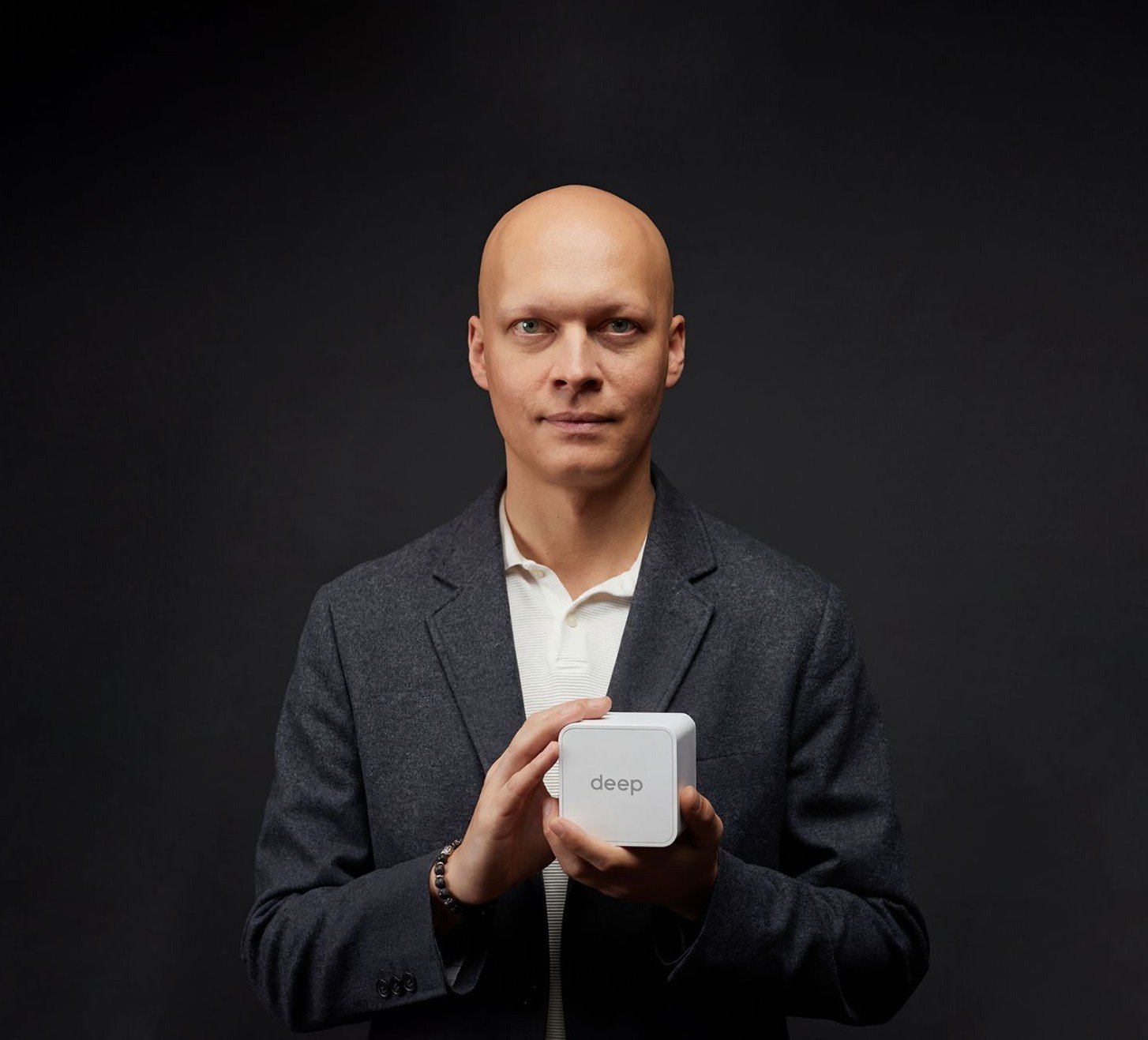
Inside the Deep Cube: Ilya Blokhin on the Architecture of Sleep
The CEO and Founder of wellness startup the Deep Cube, Ilya Blokhin, on deep sleep, magnetic fields, lucid dreaming, and the technology that is teaching us to rest again.
Ilya Blokhin is a physicist, a lucid dreaming researcher, and the creator of the Deep Cube. We met him at an exhibition dedicated to sleep – and the conversation went far beyond gadgets.
What Is the Deep Sleep Cube
Ilya, let’s start from the very beginning: what is the Deep Cube, and who is it for?
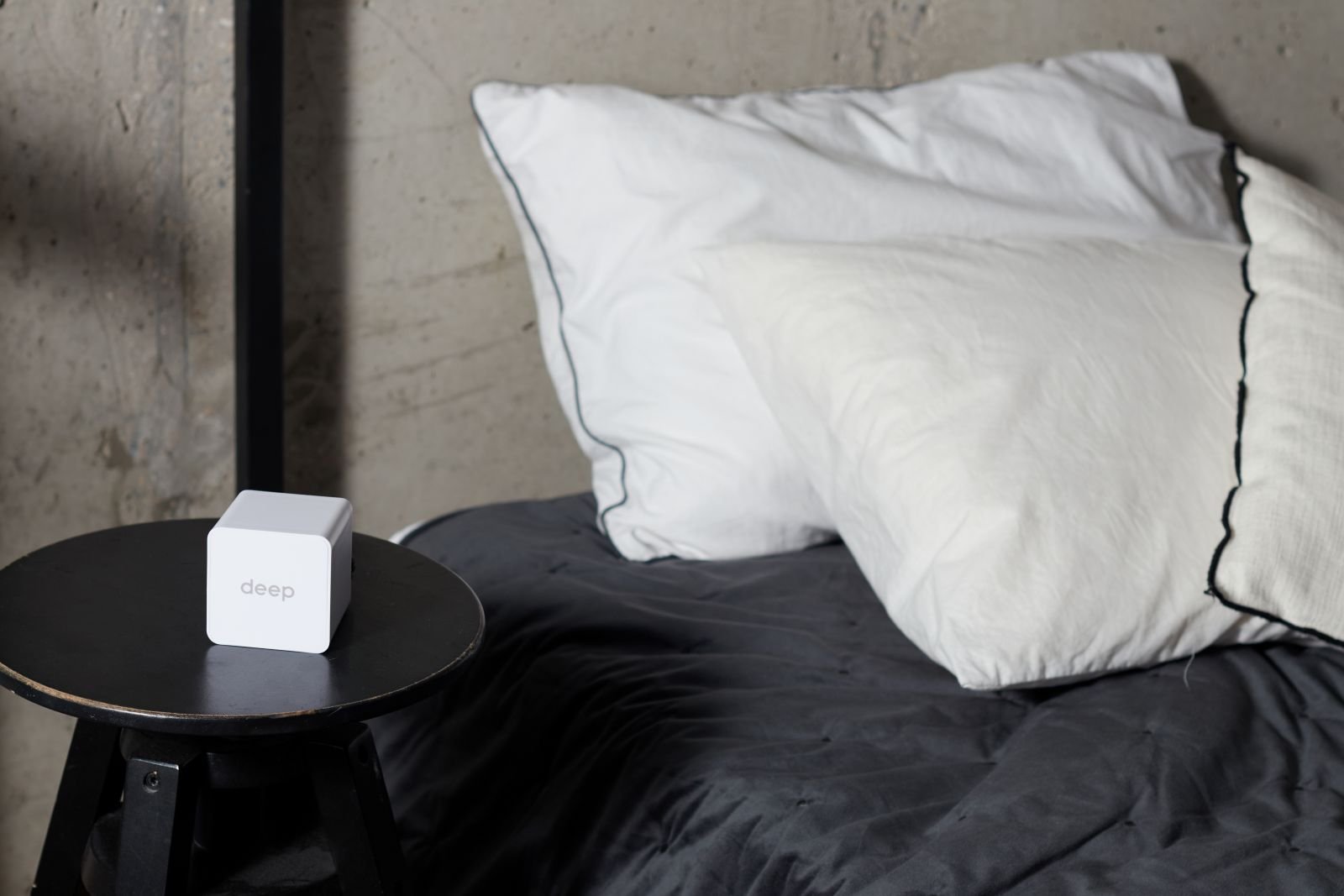
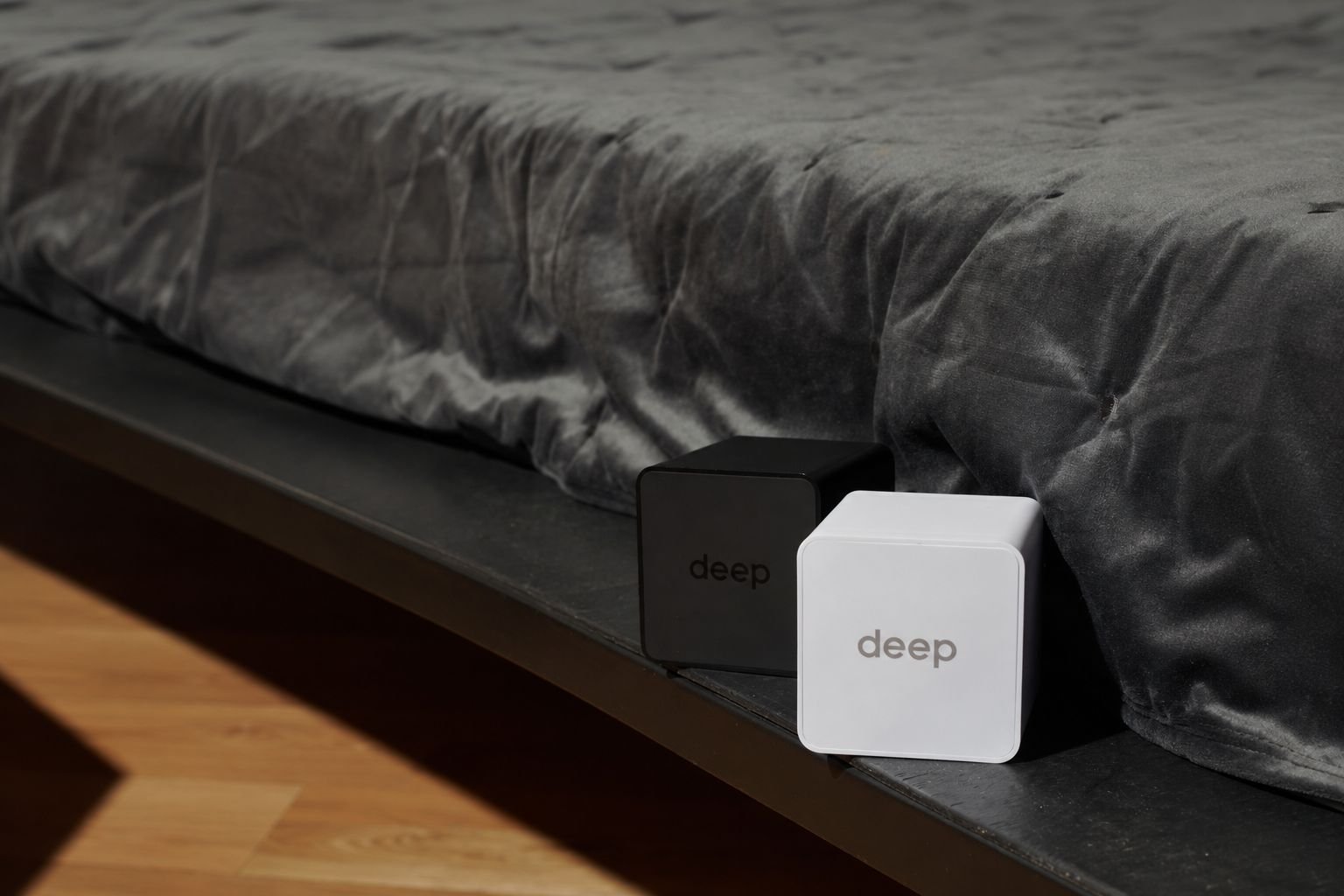
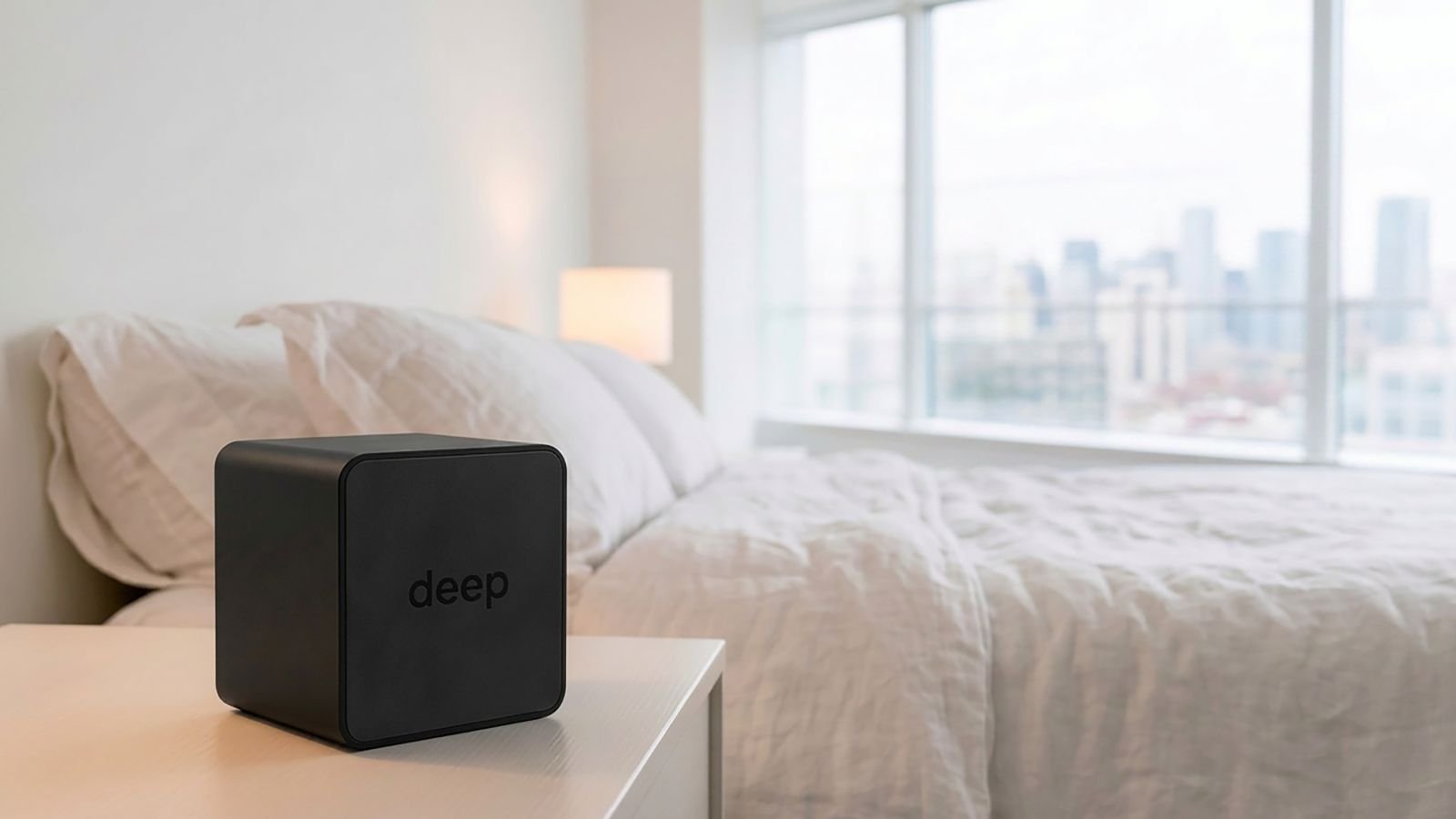
It’s a wellness device designed to improve sleep quality. A compact unit you place beside your bed at night – it generates low-level magnetic pulses comparable to Earth’s geomagnetic field, and helps the brain enter deep sleep and stay there.
It’s for people who struggle to fall asleep, wake up frequently, or don’t feel rested in the morning. But also for those who sleep reasonably well and want to go further: working with their dreams, their mental health, their awareness.
Tell us about yourself – how did you end up working on sleep?
I’m a physicist, with a degree in solid-state physics. I also studied quantum physics, nanotechnology, and superconductivity.
But my fascination with lucid dreaming goes back to childhood – it’s simply part of who I am. For me, waking reality and dreaming are two sides of the same coin; you can’t separate them. There’s no such thing as “sleep” in the sense of “time when I’m not here.” I’m always present – either here, or there. Dreaming showed me where I most wanted to be.
How did that personal experience grow into a technology?
A European venture fund once told me: if you can build a device that induces vivid lucid dreams, that would be enormously valuable. So originally, the technology was aimed at controlled dreaming.
I already had students working with me on lucid dreaming across different countries, and we started collecting data on sleep quality – were there nights when everyone slept badly, or nights when everyone slept well, had vivid dreams, woke up refreshed?
That’s how we found our way to geomagnetic conditions. We noticed that the geomagnetic storm index correlates well with how people sleep. That led us to a hypothesis: a weak magnetic field comparable to Earth’s own could influence sleep quality. From there, it became an experimental process of developing the technology to actually apply that field to the body.
How do you explain the mechanism behind the Deep Cube’s magnetic pulses?
Our hypothesis is that the body’s cells can respond to subtle changes in the magnetic field. The idea is that they contain magnetosensitive mechanisms – specialized proteins that evolved over time. So through the Deep Cube, we’re not acting on the brain directly – we’re acting on every cell in the body, and those cells then become a secondary source of periodic signals for the nervous system.
What exactly happens in the brain when we fall asleep?
When we’re awake, neurons fire in a fairly chaotic way. Run an EEG and you’ll see signals piling on top of each other – like an orchestra before a performance: someone tuning a violin, someone running through scales, someone drumming, someone talking.
When we fall asleep, the brain’s job is to bring all of that into order – to get the neurons firing together, at a single shared rhythm. That’s delta sleep, the delta rhythm. Either it’s there or it isn’t. When it is, you sleep deeply. When it isn’t, you wake up feeling like you never slept at all.
The brain has pacemakers for this – specialized centers that nudge neighboring neurons into a common rhythm. But when stress takes over, or those internal pacemakers start to falter, the whole thing begins to unravel: first you can’t fall asleep, then you lose deep sleep, and eventually you’re looking at chronic insomnia. The Deep Cube, in this framework, acts as an external conductor: it doesn’t play the music for the orchestra, but it sets a steady rhythm that makes it easier for the musicians to start playing together.
With infants, for instance, those pacemakers aren’t yet developed at birth, which is why you rock them to sleep. Rocking sends a steady rhythmic signal through the vestibular system – and the body follows.
But beyond deep sleep, the Deep Cube has another mode – one that helps you remember your dreams more vividly. What’s the point of that?
Memory is more intricate than most people realize. The hippocampus acts as working memory during the day – taking in everything, recording it all. At night, it flips: instead of collecting, it transmits. Everything accumulated during the day gets sorted into long-term memory – filtered, reorganized, some of it discarded, some stitched together with older material.
For any of that to be written, the brain has to ‘illuminate’ a specific area of the cortex – charge it up, essentially. And whatever’s already stored there activates too: memories, associations, linked images. They merge into a current of thought and imagery – which may be exactly what dreams are made of.
But new experiences aren’t normally recorded during sleep. The hippocampus is closed to input, so whatever we experience in a dream dissolves quickly, like fog. In the moment of waking, it cracks open briefly, and the last impressions slip through. That’s why we feel like we remember something.
In dream mode, the Deep Cube tunes the pulse frequency to gently influence that process. We describe it as a light activation of the hippocampus: it partially opens during sleep, allowing some of the dream experience to be retained. Remembering your dreams is the first step – and once you can do that, you can start to shape them.
How do you explain that mechanism to someone hearing about it for the first time?
I usually use the analogy of an elderly librarian. Every day, new books are piled on his desk, and his job is to shelve them overnight. He picks up a cookbook – where does it go? Next to horror, or something more inviting? That depends on what’s already on the shelves. Once a section exists, new books find their way there automatically.
When you start rewriting that during a dream – placing a book somewhere new – you’re building new clusters, a new architecture of experience. The Deep Cube gives people a way into that process, a chance to peek through the keyhole at how the mind actually works. But the work itself has to be done by the person.
Lucid Dreaming as Therapy
That starts to sound a lot like psychotherapy.
When you become aware inside a dream, the brain stops treating events as real threats. You know the wall of fire won’t hurt you. You can fly, speak in front of a crowd without panic – and your brain is still recording all of it as real. You gain genuine experience, but without the fear. And that stays with you.
If a wall of fire keeps showing up in your dreams, all it takes is one moment – you stop, and you recognize: this is a dream. Not to run, not to wake up, just to understand that nothing here can hurt you. The nightmare disappears. But behind its disappearance lies a whole layer of inner work – you’ve resolved something that had been sitting there for years. That’s what makes dreaming a place where you can rewrite old scripts.
So our dreams are actually telling us something?
Dreams are a litmus test for everything we carry inside – our conflicts, anxieties, patterns. The ones who befriend their dreams are usually at peace with themselves too.
The Deep Cube helps build awareness within sleep – but awareness alone isn’t enough; you have to work with it. Inside our app there’s a full learning ecosystem: courses on healthy sleep, on working with dreams, and on moving toward controlled dreaming. This process needs guidance – and we provide it, every step of the way. The expertise behind those courses is something I stand behind personally, one hundred percent.
“Dreams are a litmus test for everything we carry inside – our conflicts, anxieties, patterns. The ones who befriend their dreams are usually at peace with themselves too”
And yet you position the Deep Cube firmly in the wellness category.
We deliberately chose the wellness path rather than the medical one, to break down a mental barrier: healthy sleep is achieved through good habits, not medicine. We don’t classify meditation, rocking, or lullabies as medicine – even though they work.
That said, we did carry out preclinical testing. The first prototypes were built in 2015 and we started testing them on ourselves. From there, several full life-cycle animal studies, then placebo-controlled trials with EEG monitoring and polysomnography – three rounds, 25 participants each. Dozens of conference abstracts. What we found, objectively: subjects spent more time in deep sleep, and woke up less.
Can you become dependent on sleeping only with the Deep Cube?
It depends on your starting point. If you’re dealing with acute insomnia, use it until the situation stabilizes, then find your natural level. If you’re generally fine, use it on demand. Most of us can read the signs – you overdid it, went to bed late, you feel tense – so you proactively switch it on.
The Deep Cube also works as a meditation device – and younger users resonate with that instinctively. Haptic vibration, mindfulness, body awareness: it’s already their language. Brain-wise, meditation sits somewhere between waking and sleep. Ten to fifteen minutes in that state at the height of a stressful day can do what a short nap does. It keeps the brain from tipping over.
Why has sleep become such a widespread problem these days?
Greed, honestly. Greed for experiences, work, tasks, opportunities, everything. The core problem is that we try to fit everything in by cutting into sleep.
The recommended amount is seven to eight hours – but how many people can actually afford that today? Sleep has become a luxury. We want more, so we work more, take on more stress, and keep stealing time from the night. The body tolerates it – until it doesn’t, and by then the damage isn’t always undone. Covid probably pushed all of this further along. The bill comes due earlier than people expect – not at seventy, but at thirty-five.
So where does that leave us – should we be learning to slow down ourselves, or leaning on technology to do it for us?
Ideally, we should learn to do it ourselves. But the reality is we’ve boxed ourselves in: the pace of life, the endless wants, the schedules, the sleep we keep borrowing against. We can’t just ship everyone off to a monastery or a village somewhere.
Right now, we are talking at an exhibition at the M’ARS Museum – “Dream in the Museum” – where we’re one of the partners. People come for the art and stumble into sleep technology. Those who come for the technology find themselves inside a space of art.
Technology shouldn’t be a crutch for human potential. It should become a compromise between the constraints we’ve placed on ourselves and the quality of life we want to preserve. When it comes to sleep and meditation, it’s also about creating a ritual, as the only things that truly work are the things that become habits. Our job is to build that habit through the right tool – and from there, people move forward on their own.
Share




WE RECOMMEND
“Dubai Doesn’t Let You Stop. That’s Exactly the Problem”
Dr. Sarah Rasmi, psychologist and founder of Thrive Wellbeing Centre Dubai, on anxiety in a city that never pauses, the illusion of…

How to Sleep When the World Feels Unsettled
There are nights when the body is tired, but sleep still does not come easily. Or it comes lightly, in fragments. In…
The Rise of Neurowellness in Dubai: A conversation with MindTune Founder Ramzi Shehadeh
Inside the startup bringing brain training technology out of elite labs and into your daily routine.
